title: 一句话系列 date: 2015-03-06 15:22:01 categories: [编程]
tags: [一句话]
一句话或一幅图解释原理。
overriding vs overloading
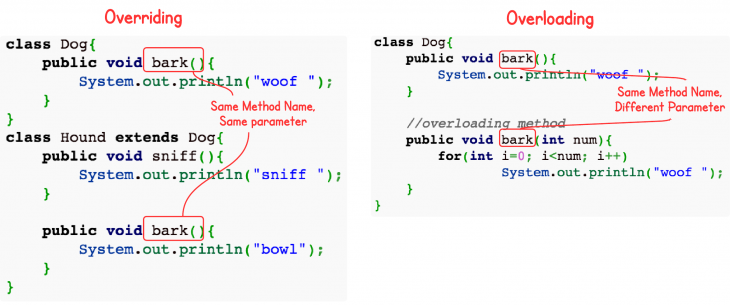
图片[来源][override-vs-overload]。
依赖注入(DI, Dependency Injection)
// 非依赖注入
public class Human {
    //...
    Father father;
    //...
    public Human() {
        father = new Father();
    }
}

// 依赖注入
//  - 非自己主动初始化依赖,而通过外部来传入依赖的方式,我们就称为依赖注入。
public class Human {
    //...
    Father father;
    //...
    public Human(Father father) {
        this.father = father;
    }
}
在Java中,什么时候可以省略数组的大小?
一句话:声明的时候可以忽略,但是创建的时候不能省略,因为数组的大小是不可变的。
int[] a;    // ok, declare.
int[][] a0; // ok, declare.
int[][] a1 = new int[3][]; // 第一个尺寸不能省略,第二个则可以。
a1[0][0] = 1; // fail. null pointer.
int[][][] a2 = new int[3][][]; // ok, 同上。
不论是多少维的数组,创建时第一个维度信息都不能省略,其他维度信息则可以省略,为什么? 答: 一个N维数组其实可以就是:一个一维数组,其元素为N-1维的数组。所以创建N维数组的时候, 第一个维度信息不能省略,但是试图访问具体元素时就会出现空指针,因为并未开辟内存空间。
如何获取数组和字符串的长度信息?为什么?
int[] arr = new int[3];
System.out.println(arr.length);
String str = "abc";
System.out.println(str.length());
因为数组对象有一个length属性,而且是不可变的,而字符串使用字符数组保存数据,
字符数组本身就有长度信息,所以String没有length属性,故提供length()方法。
Java中,equals()和hashCode()的关系
两个对象,
- 如果equals()为true,则hashCode()返回值一定相等
- 如果hashCode()返回值相等,equals()不一定为true
在HashMap中,查找对象时,首先根据其hash code进行快速定位,如果找到了,在根据
equals()值判断是否相等,如果相等则找到了,否则就返回Null。
所以,
- 如果两个对象equal,但是hash code不相等,则要么第一步就找不到,要么第二步 equals()为false,总之就是找不到该对象。
- 如果两个对象hash code相等但是equals()为true,则会把不同对象hash到同一个“槽”里面, 但是这种情况是运行的。
Java中的各种initializer
public class Foo {
    // instance variable initializer, 等价于instance initializer
    String s = "abc";

    // constructor
    public Foo () {
        System.out.println("constructor called") ;
    }

    // static initializer
    static {
        System.out.println("static initializer called") ;
    }

    // instance initializer
    {
        System.out.println("instance initializer called") ;
    }

    public static void main(String [] args) {
        new Foo();
        new Foo();
    }
}
输出,
static initializer called
instance initializer called
constructor called
instance initializer called # 第二个对象的输出
constructor called
instance initializer不常用,比较可以在构造函数里面做这些事情就好了, 但是有一种情况:匿名内部类,可以使用instance initializer,并将它没有自定义的 构造函数。
HashMap<String, String> m = new HashMap<String, String>() {
    {
        // instance initializer
        put("a", "1");
        put("b", "2");
    }
};
Java exceptions
一句话:
- cheched exception表示program之外发生的异常,program对此无能为力,需要programmer介入处理,如file not found;
- unchecked exception表示program本身发生的异常,是program自身的逻辑问题,如除数为0。
Exception hirachy:
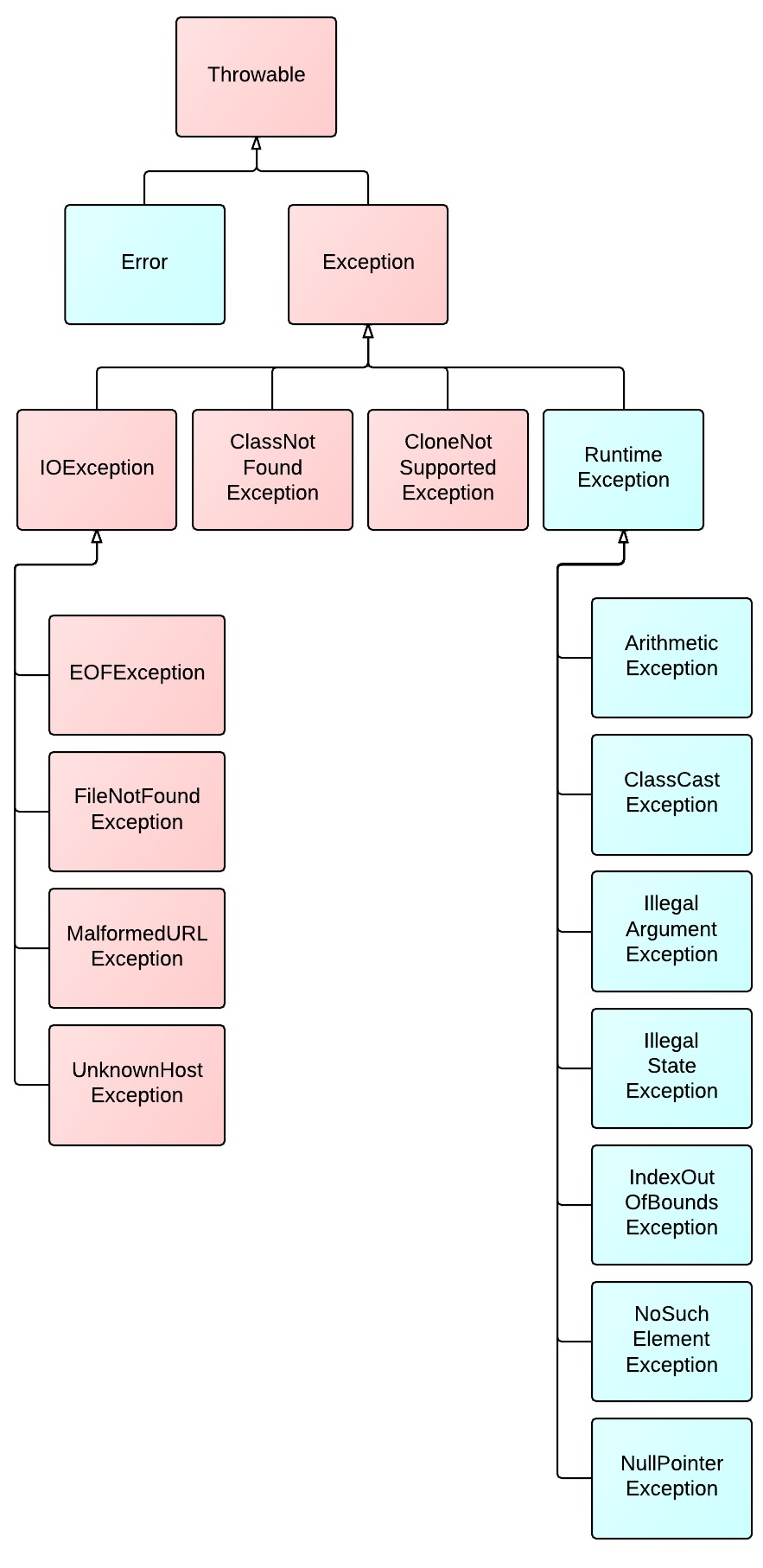
红色表示checked exception,蓝色表示unchecked exception。
compiler会关注checked exception,这类exception必须处理,否则编译不过。
所有Exception均可以捕获,
    int a = 0;
    a = 1/0; // 编译没有问题,运行错误。下面的代码,编译、运行均正常。

    try {
        a = 1/0;
    } catch (RuntimeException e1) {
    }
    System.out.println(a);

    C c = null;
    try {
        c.c = 0;
    } catch (RuntimeException e) {
        c = new C();
        c.c = 1;
    }
    System.out.println(c.c);
代码[来源][dependency-injection]。